Stakeholder map [SBM-2]

In the Pekao Group, we treat our relationships with stakeholders as a priority. We ensure continuous dialogue with groups key to our business from the external and internal environment, which we conduct, inter alia, in the form of direct conversations or interviews as part of satisfaction or engagement surveys. This enables us to obtain information about our offering, the manner and quality of service, as well as to monitor current market trends and identify the needs and expectations of market participants.

We use various forms of communication, ensuring equal access to high-quality information for all stakeholders. The way we communicate with the external environment is governed, inter alia, by the Principles of the Bank Pekao Information Policy for Contacts with Investors and Securities Market Analysts, the Media and Clients, available on [the website].

In 2024, for the first time, we identified our stakeholders and grouped them into specific categories for sustainability reporting purposes in accordance with CSRD and the ESRS Regulation. For this purpose, we first carried out sector classification and then developed a tool for mapping the Pekao Group’s value chain in the area of credit institution activities. As a result of this process, a list of stakeholders was created and submitted for assessment by eighteen business units operating in the Pekao Group. Ultimately, after integrating and analysing the collected information, we identified key stakeholder groups, as shown in the chart below.

Stakeholder map of the Pekao Group:
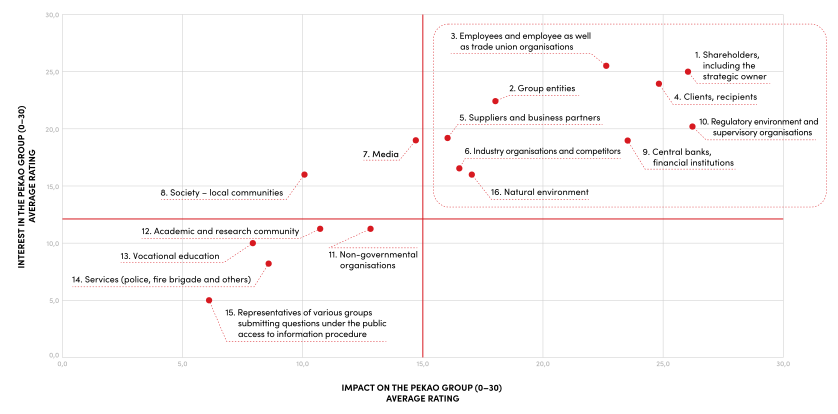
In 2025, we maintained the existing business model and key stakeholder groups, which means that the stakeholder map remained unchanged compared to 2024 – the first year of applying ESRS requirements. Due to the absence of material changes in the structure and environment of the Pekao Group, there was no need to conduct additional consultations or modify the double materiality assessment process. We maintained the existing approach, considering it adequate to the current conditions.

As part of the double materiality assessment, we conducted consultations with stakeholders (both within the organisation as well as in the upper (upstream) and lower (downstream) parts of the value chain) on the Pekao Group’s impact on the environment in terms of sustainability matters indicated in the ESRS Regulation. In the consultation process, we used a survey that enabled stakeholders to submit any additional remarks in open questions. The survey contained a total of 42 questions from the following categories: general (1), environmental (18), social (14) and corporate governance (5), as well as an open question. Respondents were divided into 2 groups: internal stakeholders, including employees and subsidiaries (78%), and external stakeholders (22%). Persons who were not employees, constituting own workforce, did not participate in the survey. The task we set for consultation participants concerned identifying and determining impacts in the ESG areas and assessing them as positive or negative. Stakeholders indicated the strongest positive impact in the social area and the strongest negative impact in the corporate governance area.

With respect to the identified impacts of the Pekao Group on the environment, and in particular in order to maximise positive and minimise negative impacts, we undertake activities involving key stakeholders. A list of these activities by individual groups is presented in the table below.

STAKEHOLDER GROUP COMMUNICATION TOOL TOPICS ADDRESSED BANK’S ACTIONS
Shareholders, including the strategic owner (1) General Meeting of Shareholders
Conferences and meetings
Stock exchange and press releases
Financial reports, data summaries and results presentations
The Bank’s website and online information channels
Meetings with rating agencies
Ongoing cooperation of the Investor Relations Department (institutional and individual investors, financial analysts and capital market organisations)
Online ESG report
Branches, online and mobile banking
Strategy implementation, value creation, organisational changes
Macroeconomic and market forecasts
Transparent actions, convenient and effective access to information about the Bank and its activities
Application of external regulations and market standards
Cooperation with the media – responding to enquiries
Media statements, interviews, appearances and publications by members of senior management and selected experts of the Pekao Gr
Customers and recipients (4) The Bank’s website and online information channels
Online banking platform
Helpline
Complaints
Surveys of satisfaction with products and services and service quality
Advertising campaigns and marketing activities
Product offers, mailings
Internal communication
Meetings in branches and Bank outlets
Security of entrusted funds
Ease of communication with the Bank
Offering competitive, high-quality products and services tailored to clients’ needs
Providing clear, comprehensible information, including by use of plain language principles
Ensuring many diverse channels of access to products and services and information about the Bank’s products and services
Transparent offer and contract terms
Obtaining customer feedback
Participation in the process of establishing and complying with good practices and advertising standards for financial services
Employees and employee/trade union organisations (3) Intranet, chats, discussion forums
Meetings with participation of the Management Board
Employee volunteering
Webinars
Employee appraisal
Internal publications
Thematic surveys, evaluation surveys, employee opinion survey
Whistleblowing reporting system
Meetings with employer representatives, negotiations, consultations
Meeting with suppliers, negotiations
Newsletters
Employment stability and opportunities for professional development
Market-based, competitive remuneration system
Employee matters as one of the Bank’s strategic objectives
Transparent organisational structure
Work-life balance
Provisions of CA
Employee matters
Detailed information on social partners is available on individual intranet pages
Trade unions
Works Council
Social Labour Inspectorate
Collecting and analysing employee opinions (chats, ability for employees to submit enquiries) and providing employees with feedback on topics raised by employees
Transparent, non-discriminatory employee appraisal process taking into account employee engagement and achievements
Employee development opportunities (promotions, product training and soft skills training),
Collecting and analysing employee opinions (satisfaction surveys) and providing employees with feedback on topics concerning aggregated satisfaction survey results
Setting employees clear, measurable targets to be achieved and monitored
Adequate pay and benefits policy taking into account market trends as well as individual employee engagement and achievements
Meetings with employees and ongoing communication with employees
Ensuring a friendly workplace: including the possibility of remote work and health promotion and preventive actions
Dialogue with all trade union organisations operating in the Bank
Regulatory environment and supervisory organisations (10) E-mail
Statements, reports
Trade and business platform
Compliance with requirements and regulations
Supporting the development of new market rules, including good practices – participation in consultation processes, e.g. with the involvement of the ZBP (Polish Bank Association
Ongoing monitoring of legislative changes, the supervisor’s approach, requirements, regulations and good practices; ongoing cooperation with Regulators
Central banks, financial institutions (9) E-mail
Statements, reports
ESG matters in the financial system and the banking sector Dialogue and cooperation with stakeholders
Exchange of experience
Shaping good market practices
Entities of the Pekao Group (2) Telephone, e-mail
Meetings
Implementation of policies and procedures at Group level Cooperation in the exchange of experience and implementation of good practices
Suppliers and business partners (5) Procurement platform, telephone, e-mail
ESG form
Ongoing cooperation and contract performance
Charitable and sponsorship activities, climate actions
Transparent principles of selection and cooperation with suppliers Application of transparent supplier selection procedures
Timely performance of contract provisions
Promoting good procurement practices
Industry organisations and competitors (6) Communication on the Bank’s website and online communication channels
Non-financial reports
Results, implementation of objectives and business strategy
Initiatives undertaken and legislative and business projects implemented supporting the green transformation
Monitoring market changes in order to develop good practices
Trend analysis
Participation of Pekao Group representatives in meetings of industry organisations
Natural environment (16) Internal communication channels Social and environmental projects
Reducing adverse impact on the environment, environmental education of Customers and Employees
`Encouraging employees to participate in pro-environmental initiatives
Promoting behaviours and attitudes aimed at limiting adverse impact on the environment among employees

Search results