All strategic initiatives are reflected in the financial planning process. The Bank’s Strategy for 2025–2027 includes the objective of achieving climate neutrality by 2050, the operationalisation of which is ensured by the adopted Capital Group Transition Plan. Accordingly, the Transition Plan forms an integral element of the financial planning process.
Transition Plan [E1-1]

Transition Plan for climate change mitigation
In 2025, the Bank’s Management Board approved the Transition Plan of the Bank Pekao S.A. Capital Group (hereinafter: the Plan or the Transition Plan), the purpose of which is to support the achievement of the long-term objective of the Paris Agreement, i.e. to pursue limiting the increase in the average global temperature to 1.5°C above pre-industrial levels. The Plan sets out specific targets and actions for financed greenhouse gas (GHG) emissions related to our portfolio, as well as for our own operations relating to real estate and the vehicle fleet. The Plan will be reviewed and updated in a cycle aligned with the update cycle of the Group’s business Strategy and will also be covered by an internal process for monitoring progress against the targets set, at least semi-annually (by the ESG Council) and annually by the Management Board.

Below we present the key assumptions of the Transition Plan, split between the portfolio and own operations. We also indicate that neither the Bank nor any Group entity is an entity excluded from EU Paris-aligned benchmarks – the Group operates in the financial industry and does not conduct business activities in fossil-fuel-related industries to which the above exclusion applies.
Given that 2025 is the base year for portfolio decarbonisation targets, information on progress in implementing the portfolio Transition Plan will be disclosed starting from the report for the subsequent year, i.e. the report for 2026. As regards decarbonisation targets for our own operations, where 2024 is the base year, progress in reducing the carbon footprint for Scope 1 and Scope 2 GHG emissions is presented in the tabular disclosure E1-6 “Greenhouse gas emissions by scopes 1, 2 and 3 in the Bank and subsidiaries”, in the “% 2025 / 2024” column. The observed changes in Scope 1 and Scope 2 GHG emissions levels result from decarbonisation actions undertaken in 2025, which are described in more detail in the subsection “Actions and resources in relation to climate policy E1-3”.

Assumptions of the portfolio Transition Plan
The Plan was developed in accordance with the EBA Guidelines on the management of ESG risks[27]. Its overarching objective in relation to the portfolio is to manage ESG risks identified by the Bank as material in the short-, medium- and long-term perspective, in line with the overall business strategy and risk appetite. The Plan covers transition (transformation) risk, identified in the double materiality assessment process, related to climate and its impact on the Group portfolio’s credit risk, as this risk is closely linked to financed exposures that may be particularly exposed to the economy’s adjustment to applicable regulatory objectives relating to ESG risk, in particular EU climate policy. This is also a risk analysed through the lens of forward-looking climate scenarios containing reference target values related to decarbonisation of specific sectors, which are explicitly referenced by the EBA Guidelines.
[27] Guidelines on the Management of Environmental, Social and Governance (ESG) Risks, EBA/GL/2025/01, dated 8 January 2025.
An analysis of the rationale and feasibility of defining quantified targets for sectors financed by us and the possibility of comparing those targets with reference decarbonisation pathways derived from scientific climate scenarios was a key preparatory step prior to setting the Group portfolio’s decarbonisation targets. This analysis considered the materiality of the volume of financed emissions, the monetary materiality of exposure to a given sector, an assessment of the availability of reference decarbonisation pathways, and an assessment of the availability of source data or reliable proxies, in terms of the ability to set robust, feasible and monitorable decarbonisation targets. As a result of the analysis, the Transition Plan includes two sectors prioritised for decarbonisation:
- the power generation sector; and
- the residential real estate sector – i.e. our mortgage loan portfolio.
For these two priority sectors of our portfolio, we have set the Transition Plan’s decarbonisation targets based on GHG emissions intensity – these targets are presented in the table below:
When analysing our disclosed decarbonisation ambitions, it should be borne in mind that the pace of moving away from fossil fuels in Poland has a material impact on our ability to reduce the intensity of financed GHG emissions in the sectors covered by the Plan. The expected transformation of the national energy mix – with a growing share of low- and zero-emission sources – may significantly support the achievement of the Bank’s climate targets and those of other financial institutions; however, this process is largely dependent on the regulatory framework.
The Plan assumes decarbonisation of GHG emissions intensity (technological decarbonisation) in the priority sectors through actively increasing our involvement in financing transformation in these areas. This implies organic portfolio growth, which may translate into an increase in the absolute volume of financed GHG emissions. This is particularly relevant for the time horizon to 2030: for power generation, we assume an increase in our engagement in financing transitional generation technologies based on natural gas, which are not zero-emission technologies; and for mortgage loans, we assume an increase in the sale of loans financing energy-efficient properties, which are generally not passive buildings (with nearly zero consumption of energy from fossil fuels). At the same time, we indicate that we have not set targets in the Plan for reducing financed GHG emissions in absolute terms.
Power generation
The decarbonisation targets defined by us for the power generation industry reflect our strategic commitment to supporting the transformation of the Polish economy towards a more environmentally sustainable and long-term resilient energy mix. Financing of the power generation sector accounts for 7.15% of our portfolio GHG emissions and for 2.53% of our exposure in the corporate financing portfolio, and for 1.5% of the total credit portfolio – as of 31 December 2025.

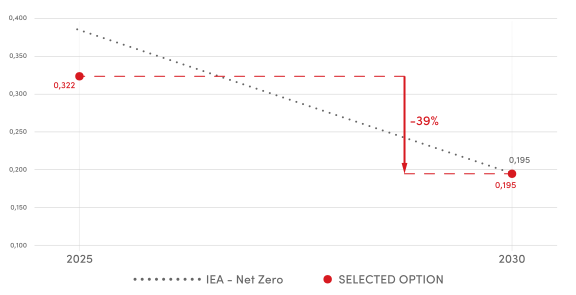
We set the decarbonisation target for this sector with reference to the “Net Zero 2050” reference decarbonisation pathway published by the International Energy Agency (IEA). This pathway assumes a reduction in the average global GHG emissions intensity from electricity generation at a pace that enables limiting the increase in the average global temperature to 1.5°C above pre-industrial level.
Our ambition is to reduce by 39.5% by 2030 (compared to 2025) the average GHG emissions intensity of generation technologies and activities in the power generation sector financed by the Bank. The target defined in this way, and the internally assumed pace of portfolio decarbonisation, will allow us to decarbonise our exposure to the power generation industry up to 2030 at a pace consistent with the model assumptions of the Net Zero 2050 climate scenario.
Pace of decarbonisation of power generation sector financing compared to the IEA Net Zero 2050 scenario
- decarbonisation actions on the Bank’s side, i.e.:
- engagement in purpose-specific financing of transitional generation technologies based on natural gas – we plan to increase our balance-sheet exposure to natural gas to 24.7% in 2030 (relative to our total exposure to the power generation sector) and, at the same time, we do not assume providing new purpose-specific financing for generation technologies based on other fossil fuels (e.g. coal or crude oil),
- maintaining a high level of engagement in purpose-specific financing of zero-emission generation technologies based on wind and solar energy – we plan that throughout the Plan horizon our balance-sheet exposure to these technologies will exceed 40% of our total exposure to the power generation sector,
- decarbonisation actions at the national level (outside the Bank’s control), expressed through the pace of implementation of the assumptions of the National Energy and Climate Plan.
- improving the quality of data on purpose-specific financing and financed GHG emissions,
- building Customer Advisers’ capabilities in the practical application of the Transition Plan assumptions,
- engaging customers in dialogue on potential financing needs for zero- or low-emission technologies.
For the power generation industry, we identify so-called “locked-in” greenhouse gas emissions (i.e. emissions that cannot be reduced quickly because they result from existing infrastructure, contracts and technologies) in relation to our exposure to financing the ongoing business activities of customers in this sector (non-earmarked financing, not allocated to specific generation technologies). The pace of decarbonisation of this financing depends solely on the national transformation of the power sector and is expressed in our Plan as the decarbonisation pace resulting from the National Energy and Climate Plan, i.e. a decarbonisation lever outside the Bank’s control.
Achievement of the targets set out in the Plan may have a positive impact on the Bank’s disclosed Green Asset Ratio within EU Taxonomy disclosures. However, the compliance of the financing granted with the EU Taxonomy technical screening criteria does not affect the targets set for power generation financing.
Residential real estate (mortgage loans)
Within our mortgage loan portfolio, we finance the purchase or construction of residential real estate by our Customers who are natural persons. The purchases of real estate financed by us relate to both the primary and secondary markets. Mortgage loans generate [5.83%] of our portfolio GHG emissions and account for [39.63%] of our exposure in the loan portfolio – as of 31 December 2025.
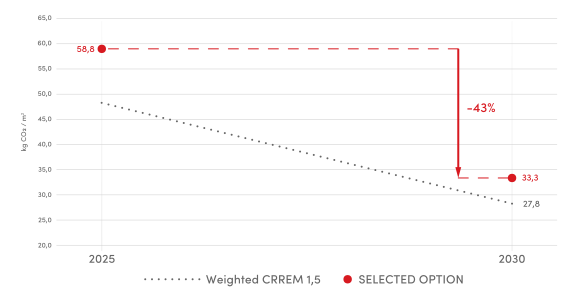
Our target is to reduce the average GHG emissions intensity of residential real estate financed by the Bank by 43.4% by 2030 (compared to 2025). This ambition and our internally assumed pace of decarbonisation over the longer time horizon will allow us to decarbonise our mortgage loan portfolio at a pace on average around 2 years slower than the reference assumptions of the climate scenario CRREM 1.5°C.
Pace of mortgage loan decarbonisation compared to the CRREM 1.5°C scenario
- decarbonisation actions on the Bank’s side, i.e.:
- a gradual increase in the share of mortgage loan sales aligned with the technical screening criteria of the Taxonomy,
- a gradual increase in the share of loan sales for energy-efficient and highly energy-efficient properties; implementation of a cap on the share of energy-intensive exposures in new sales,
- decarbonisation actions at the national level (outside the Bank’s control), expressed through:
- the planned reduction of the maximum allowable indicator of demand for non-renewable primary energy, pursuant to building regulations, for buildings constructed from 2030,
- the pace of implementation of the assumptions of the National Energy and Climate Plan.
- improving the quality of data on the energy efficiency of financed properties,
- building the competencies of Customer Advisers in the practical application of the assumptions of the Transition Plan and in the area of regulations concerning the energy efficiency of buildings.
With respect to mortgage loans, we identify so-called locked-in greenhouse gas emissions (i.e. emissions that cannot be reduced quickly because they result from already existing infrastructure, contracts and technologies) in relation to the financing of multi-family properties on the secondary market, particularly for properties using district heating. The pace of decarbonisation of these properties depends largely on the national transformation of the power and district heating sectors, i.e. decarbonisation levers outside the Bank’s control.
Assumptions of the Transition Plan for own operations
In the ESG risk materiality analysis performed in 2025, we did not identify environmental risks related to own operations as material. Nevertheless, due to the strategic ambition to build the image of a sustainable and environmentally responsible institution and the need to address the disclosure requirements in this area, we decided to include GHG emissions from own operations in our Transition Plan.
Our Transition Plan for own operations focuses on scope 1 and scope 2 emissions, over which we have real control. For these scopes, we also carried out a preliminary preparatory analysis aimed at identifying the most material sources of GHG emissions – these are:
- scope 1 and scope 2 emissions generated by our properties from electricity and from the use of refrigerants – they account for more than 85% of the carbon footprint in scope 1 and 2 on a location-based basis and just under 80% on a market-based basis, and
- scope 1 emissions generated by fuel combustion in our vehicle fleet – they account for approx. 12% of the carbon footprint in Scope 1 and 2 on a location-based basis and 18% on a market-based basis.
As a result, we decided to set quantified decarbonisation targets for Scope 1 and 2 emissions resulting from electricity and heat consumption in our properties, and for Scope 1 emissions resulting from fuels combusted by our vehicle fleet. Decarbonisation targets were defined as targets for the reduction of absolute emissions. Additionally, for properties, a target based on GHG emission intensity per m² of our office space was set.
Overall decarbonisation targets for Scope 1 and 2 GHG emissions
Decarbonisation pathway for Scope 1 and 2 GHG emissions of the Pekao Group compared with the IEA Net Zero 2050 scenario
Properties
We have set decarbonisation targets for our properties in two approaches:
- in terms of absolute emissions reduction, and
- in terms of reducing GHG emissions intensity per m2 of properties.
The targets expressed as absolute emissions reductions are compared with the reference “Net Zero 2050” scenario published by the International Energy Agency (IEA). This scenario assumes a reduction in global GHG emissions (starting from 2023) at a pace consistent with limiting the increase in the global average temperature to 1.5°C above pre-industrial levels. We present these targets in the table below.
Absolute GHG emissions reduction targets for Scope 1 and 2 emissions from properties
Decarbonisation targets expressed as reductions in GHG emissions intensity per m2 of properties were set relative to the reference decarbonisation pathway “CRREM 1.5°C” published by the recognised organisation Carbon Risk Real Estate Monitor (CRREM). We present these targets in the table below.
Targets based on GHG emissions intensity per m2 of office floor area
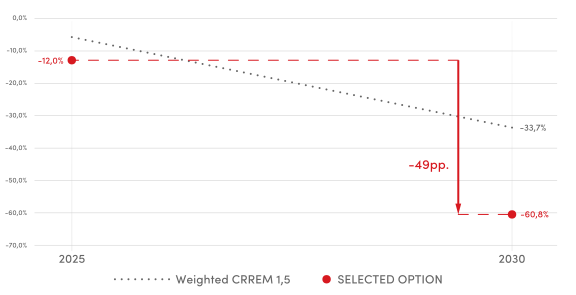
In the chart below we compare our property decarbonisation targets with the CRREM 1.5°C model decarbonisation pathway. Already in the base year, the emissions intensity of our properties is lower than assumed under the CRREM 1.5°C scenario. By 2030, we expect to decarbonise our properties at a pace that will allow us to achieve targets more ambitious than those assumed in the CRREM 1.5°C scenario.
Comparison of intensity-based decarbonisation targets with the CRREM 1.5°C pathway
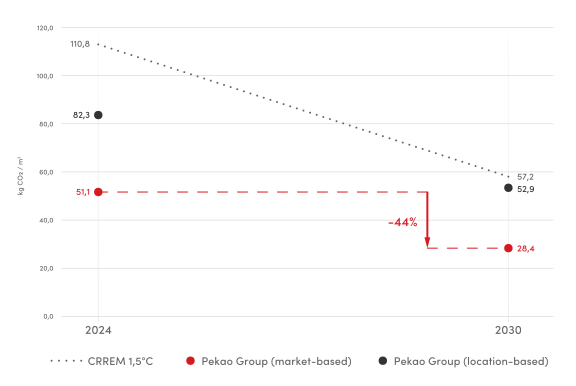
Our assumptions regarding decarbonisation of properties within Scope 1 and 2 of our operational GHG emissions are more ambitious than the reference pathways under scenarios assuming limitation of global warming to 1.5°C.
- Decarbonisation measures on the Bank’s side:
- reduction and modernization of the Bank’s office floor area,
- increasing the share of purchased electricity covered by renewable energy guarantees of origin and renewable PPAs.
- Decarbonisation measures on the national side (outside the Bank’s control), expressed through the pace of implementation of the assumptions of the National Energy and Climate Plan.
- improving the quality of data on GHG emissions from district heating,
- training the employees of the Bank and the Pekao Group responsible for property management and energy-related contracts in the assumptions of the Transition Plan.
For our properties, we do not identify so-called locked-in GHG emissions.
Fleet of company vehicles
As of 31 December 2024, company vehicles in our Group were mainly petrol-powered vehicles. In 2025, we made a strategic decision to decarbonise our fleet by replacing more than one thousand petrol vehicles with hybrid vehicles. As a result, at the end of 2025, 69% vehicles were hybrid vehicles and 29% were petrol vehicles
Structure of the Pekao Group’s company-vehicle fleet by powertrain at year-end 2024 and 2025
Under our Transition Plan, we assume maintaining the strategic direction of fleet decarbonisation initiated in 2025. The key decarbonisation lever in this respect is increasing the share of hybrid vehicles in the Group’s company-vehicle fleet to 80% by 2030. Due to infrastructure-related and performance/cost challenges associated with electric vehicles, our first Transition Plan does not assume increasing their share in the fleet. We do not rule out revisiting this assumption in future updates of the Plan as technology progresses in this area. We compare the fleet decarbonisation target expressed as absolute emissions reduction with the reference “Net Zero 2050” scenario published by the International Energy Agency (IEA). This target is presented in the table below.
Absolute GHG emissions reduction target for Scope 1 and 2 emissions from the vehicle fleet
With respect to our vehicle fleet, we identify so-called locked-in GHG emissions (i.e., emissions that cannot be reduced quickly because they result from already existing infrastructure, contracts or technologies) arising from three factors:
- due to the need to maintain the operational efficiency of our organisation, we do not assume reducing the number of company vehicles in the Plan,
- due to infrastructure-related and performance/cost constraints, we do not assume increasing the share of electric vehicles in the fleet in the Plan,
- hybrid vehicles will burn fuel and thus generate Scope 1 GHG emissions; any reduction will depend, in particular on technological progress in the fuel efficiency of such vehicles.