

Supplier relationship management [G1-2]

Cooperation with suppliers – regardless of the scale of their operations – is of key importance to us. Each partner is selected transparently, in accordance with our procedures, market best practices and applicable laws. We do not have a dedicated policy for preventing payment delays.

Procurement Policy

In the Bank, procurement processes are governed by three primary internal documents: the Procurement Policy of Bank Polska Kasa Opieki S.A. (hereinafter: the Procurement Policy), the Rules for procurement conducted by the Procurement Department (updated in January 2026), and the Rules for procurement conducted without the involvement of the Procurement Department (updated in March 2025). The Procurement Department is responsible for implementation, management and monitoring of these policies, as well as for improving procurement processes.

The Procurement Policy is a tool for implementing the strategic vision for the development of the procurement function and ensures transparency, compliance with ESG principles and uniform standards for procurement proceedings. This policy governs the organisation and oversight of procurement processes in the Bank and covers the entire procurement cycle – from procurement planning, through supplier selection, contract execution and supplier cooperation, to reporting and monitoring of results. Oversight of these processes is exercised by the Procurement Department, which is responsible for process management, monitoring effectiveness, improvement, initiating cooperation and setting performance indicators. After each contract is completed, an assessment is carried out jointly by the Contract Administrator and the Buyer. In addition, the Management Board receives a quarterly report covering all procurement processes conducted by the Bank.

The Procurement Policy takes into account the interests of:

  • suppliers – through clear rules of cooperation, a procurement platform and the supplier zone;
  • the Bank’s organisational units – through support, guidelines and procurement tools;
  • the Capital Group – through joint projects, benchmarking and cost synergies;
  • s• society and the environment – through the implementation of ESG principles.

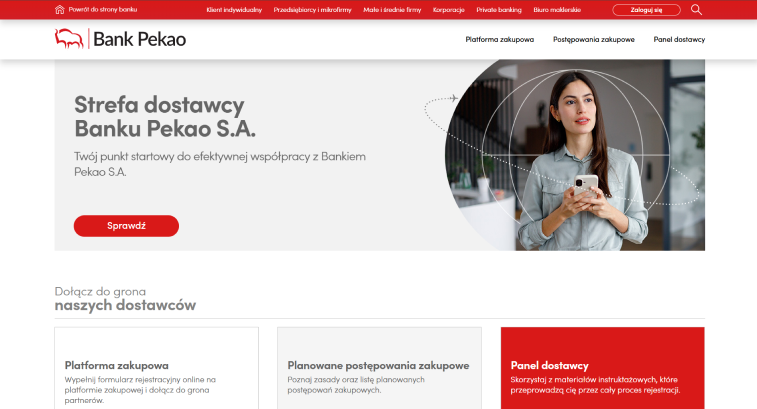
We make the Procurement Policy available on the Bank’s intranet. Documents and communications related to Procurement Processes are published in the [Supplier Zone].

Supplier Code of Ethics

In the Supplier Code of Ethics of Bank Pekao S.A. (hereinafter: the Supplier Code of Ethics), we set out the rules for cooperation with suppliers and their subcontractors. In this way, we promote social responsibility, transparency, sustainable development, respect for human rights and the principles of business ethics.

The purpose of the Supplier Code of Ethics is to ensure that suppliers act in accordance with the Bank’s values and support its ESG strategy. The document contains no explicit exclusions but requires the supplier to submit a statement confirming that they have read it and undertake to comply with its principles. In accordance with the Supplier Code of Ethics, the Bank may identify potential breaches and take corrective actions, which ensures the effectiveness of the implemented principles.

Under the Supplier Code of Ethics, we expect our partners to meet specific criteria in individual ESG areas:
  • holding valid permits, licences, notifications, declarations, agreements and decisions relating to environmental protection in connection with their operations;
  • timely payment of environmental charges for use of the environment;
  • compliance with relevant environmental reporting requirements;
  • striving to minimise the adverse environmental impact of their operations;
  • efficient resource management;
  • reducing the consumption of materials and raw materials;
  • managing waste in accordance with applicable legal requirements;
  • undertaking actions aimed, inter alia, at reducing greenhouse gas emissions within the organisation and its supply chain and related disclosures;
  • promoting environmental protection actions.
  • employees’ right to terminate employment at any time;
  • prohibition of any forms of forced labour, child labour and employee discrimination;
  • timely payment of remuneration and compliance with rules on deductions from remuneration;
  • counteracting bullying (mobbing) and discrimination in the workplace;
  • the right to freedom of association, collective bargaining and choosing representatives in accordance with the law;
  • monitoring and assessment of employees’ exposure to health and safety hazards, including harmful chemical, biological, physical and ergonomic factors;
  • providing personal protective equipment and information on risks arising from OHS hazards and fire safety regulations.
  • protection of legally protected information;
  • timely settlement of financial obligations;
  • counteracting corruption;
  • counteracting money laundering and the financing of terrorism and criminal activity;
  • consumer protection;
  • maintaining professional secrecy and business secrecy;
  • protection of personal data;
  • antitrust prevention;
  • applying the principles of fair competition;
  • counteracting conflicts of interest;
  • protection of intellectual property and transfer of technology and know-how.

In the Supplier Code of Ethics, we take into account the interests of key stakeholders by, inter alia, promoting fair working conditions, counteracting discrimination, bullying (mobbing) and child labour among our suppliers’ employees, supporting social initiatives for local communities, requiring actions for environmental and climate protection, and ensuring compliance with laws and ethical principles towards the Bank’s customers. In the area of counteracting discrimination and bullying, compliance with these requirements is additionally verified through questions included in ESG Forms completed by suppliers each time as part of procurement proceedings. In addition, the document refers to: the Ten Principles of the United Nations Global Compact (human rights, anti-corruption, environmental protection), the Pekao Group Code of Conduct and the Bank Pekao Strategy. Responsibility for managing the Supplier Code of Ethics arises from the Bank’s internal regulations and is assigned to the Procurement Department within the Finance Division. We make its full text available on our website under [Corporate governance].

The Supplier Code of Ethics is a guiding document, and to obtain information on sustainable development criteria we use ESG Forms completed based on the supplier’s self-classification depending on the definition applicable to the enterprise.
ESG Form

By introducing a requirement to complete an ESG Form for all procurement proceedings, regardless of their value or the size of the potential supplier, we clearly emphasise the importance of actions in support of sustainable development, environmental protection and respect for human rights throughout the supply chain. Enforcing this requirement expresses responsibility towards business partners and the social environment, while at the same time enabling ongoing monitoring of compliance with the adopted standards without identifying material risks in this area.

  • assess suppliers’ level of engagement in sustainable development activities;
  • verify compliance with the Code of Ethics;
  • obtain information on policies, procedures and practices applied by suppliers in the environmental, social and corporate governance areas;
  • manage ESG risk in the Bank’s supply chain;
  • support transparency and accountability in business relationships.

Rules for procurement conducted by the Procurement Department

The Rules for procurement conducted by the Procurement Department (hereinafter: the Procurement Rules) are a comprehensive document governing the entire procurement process, from planning needs to finalising the order and acceptance of deliveries/services/works. Their main purpose is to ensure consistency, transparency and compliance with the Bank’s procurement policy, as well as adherence to ESG standards in the supply chain, operational efficiency and control of procurement risks. This document not only describes the specific stages of the process, but also defines the roles and responsibilities of participants, including the Procurement Department, substantive units and the Management Board.

The procurement process begins with planning, which is carried out cyclically and reported to the Management Board. Next, requisitions are submitted, which are analysed and approved. Supplier selection is based on recommendations and evaluation of bids, using tools such as an evaluation sheet that includes formal, commercial and substantive criteria. The entire process is documented in the form of a supplier selection recommendation, and any deviations from procedures are reported to the appropriate control units, such as the Audit Department or the Bank Security Centre.

The Procurement Rules apply to all procurements carried out by the Procurement Department, except those covered by separate procedures – e.g. procurements up to PLN 100,000 net, emergency procurements, technical procurements, procurements from electronic catalogues, or those related to outsourcing and real estate. The document provides that the Director of the Procurement Department is responsible for implementation and interpretation of the rules, while the Management Board approves procurement decisions in strategic areas such as outsourcing or consultancy services.

An important aspect of the Procurement Rules is their integration with group policies and external standards. Procurement proceedings require the use of ESG Forms, the Supplier Code of Ethics, Anti-corruption Rules and the Whistleblowing Procedure. EBA, DORA and GDPR guidelines are also taken into account. This ensures that the procurement process not only meets formal requirements but also supports sustainable development and social responsibility objectives.

We make the Rules available on the intranet together with document templates, instructions and communications. In this way, we create a coherent system that enables effective procurement management in a large financial institution while maintaining high ethical, operational and regulatory standards.

Rules for procurement conducted without the involvement of the Procurement Department

The Rules for procurement conducted without the involvement of the Procurement Department differ from the rules applicable to procurements conducted by that department primarily in terms of scope of application, the degree of procedural regulation and control mechanisms. Procurement without the Procurement Department primarily concerns lower-value transactions – up to PLN 100,000 net – and those included on a list of subject-matter exclusions, such as procurements related to HR, taxes, donations or trainings. Unlike the full procurement process, these procurements are simplified and operational in nature, allowing the Bank’s organisational units greater autonomy in meeting procurement needs.

Requisition registration takes place only in selected cases, and budget control is carried out by the budget owner or the project manager. For procurements with a value exceeding PLN 10 million net, approval by the Management Board is required. Responsibility for executing the procurement lies with the organisational units managing projects or budgets, while the Procurement Department plays an interpretative role.

Training on the Procurement Policy, the Procurement Rules and the Integrated Procurement Tool (Procurement Platform) is delivered in the Bank by the Procurement Department. This training is intended to provide Bank employees with appropriate knowledge enabling them to understand the rules governing procurement processes.

We want to ensure that they can apply internal regulations in practice and navigate the Integrated Procurement Tool environment, and that they are aware of their role and responsibility in the procurement process, acting in accordance with the principles of transparency and ESG compliance

The training is addressed to internal customers, i.e. employees who submit training requests, budget owners responsible for financing procurements, members of procurement teams (participants in proceedings), Procurement Department employees involved in implementing procedures, and supporting units such as the Financial Planning Department, the Legal Department or the Bank Security Centre.

We deliver training in the form of e-learning, in-person or online workshops, as well as onboarding trainings for new employees. Training may be mandatory for specific roles, such as buyers or internal customers. The Procurement Department may also initiate training as part of process improvement.

In 2025, 367 employees were trained during dedicated sessions delivered by Procurement Department staff. In addition, 235 employees completed training in the e-learning system

Organisational culture

Responsibility for strengthening our organisational culture lies with a dedicated unit – the Organisational Culture Office within the HR Strategy Centre. This is where initiatives are developed and delivered to promote the Bank’s values and support the development of our organisational culture. The implementation of individual activities is closely aligned with the Bank’s current needs – both strategic and those arising from employees’ feedback expressed in surveys (in 2024: the Employee Engagement and Satisfaction Survey, the Collaboration Survey and the Psychophysical Well-being Survey; in 2025: preparations for the Organisational Health Survey) as well as in questionnaires conducted after events such as the World Values Day or Children’s Day.

The foundation of the Bank’s organisational culture is its values and behaviour that stem from them, as well as employees’ everyday rituals and attitudes – rather than formalised guidelines. STRAIGHTFORWARDLY, TOGETHER, BOLDLY, RESPONSIBLY, WITH DETERMINATION, OPENLY and HONESTLY – these are the values on which we base our efforts to build the Bank’s culture. The values are embedded in the Strategy. They are consistently reflected in email communications to employees, during business and sports meetings, and in materials published on the intranet and in company newsletters. Their importance is also emphasised when presenting financial results, implementing new projects and in HR activities.

Topics related to organisational culture are also raised by the Management Board and highlighted during events aimed at employees. One example was the Town Hall held on 26 May 2025, during which members of the Management Board held a dialogue with employees about the updated catalogue of values. The topic of values, attitudes and behaviours is present in our communications – during presentations of quarterly and annual results, in reports of the People, Organisation and CX Division, and in the Management Board’s day-to-day engagement with employees. Other value-related initiatives are described in section [S1-1].

We support the promotion of attitudes consistent with our values through various forms of recognition. We reward employees through dedicated competitions and challenges, and in 2025 we incorporated the values into the employee performance appraisal process – employees’ behaviours are assessed for alignment with the values

  • a series of online trainings for managers and employees focused on the practical application of values in day-to-day work;
  • the Mission: Development programme – aimed at employees with high development potential;
  • the Sugar Free programme for women – supporting women’s professional and personal development within the organisation;
  • an onboarding programme – introducing new employees to the culture and values from their first days at work.

We provide space for sharing feedback and submitting suggestions related to organisational culture. The Bank has a dedicated email inbox to which any employee can send a message – whether a question, an idea or an opinion on activities in the area of organisational culture.

Minimum reporting requirements for policies in the area of business conduct:

POLICY NAME IRO Approving body SCOPE/EXCLUSIONS
Code of Conduct of Pekao Group Corporate culture Management Board Group
Code of Banking Ethics of the Polish Bank Association Corporate culture General Meeting of the Polish Bank Association (ZBP) Bank, Bank’s environment – customers, partners, local communities
Whistleblowing procedure in Bank Pekao S.A. Whistleblower protection Management Board Bank, associates, suppliers and other natural persons who may obtain knowledge about violations in a work-related context
Procedure for preventing mobbing, discrimination, harassment or other undesirable behavior in Bank Polska Kasa Opieki Spółka Akcyjna Corporate culture; Whistleblower protection President of the Management Board Bank
Anti-corruption policy in the Group of Bank Pekao S.A. Corruption and bribery: Prevention and detection of corruption, including training; Incidents of corruption and bribery Management Board Group
Supplier Code of Ethics of Bank Pekao S.A. Supplier relationship management, including payment practices Management Board Bank
Procurement policy in Bank Polska Kasa Opieki Spółka Akcyjna Supplier relationship management, including payment practices Management Board Bank
Rules for execution of procurement by the Procurement Department in Bank Polska Kasa Opieki S.A. Supplier relationship management, including payment practices Management Board Bank
Rules for execution of procurement without the involvement of the Procurement Department in Bank Polska Kasa Opieki Spółka Akcyjna Supplier relationship management, including payment practices Management Board Bank

Search results