Investing in human capital

People at the Center of HR Activities

The directions of the Bank’s HR policy result from the mission and strategy of the organization and constitute the foundation of the activities undertaken in the area of HR.

We focus on strengthening the potential of employees by developing an organizational culture based on clearly defined values, improving leadership competencies and systematically improving skills that are key to the effective functioning of the organization.

Aspirational organizational culture

In the face of the challenges facing the banking sector and in line with the assumptions of the Bank’s strategy for 2025-2027, we are building an organizational culture focused on development, dynamics of operations and aspirations to be an industry leader in key areas. Our goal is to create an organization that is ahead of the competition, thanks to a modern mindset, rapid decision-making, and the courage to implement change.

The foundation of our organizational culture is based on clearly defined values, redefined and communicated in conjunction with our Strategy. SIMPLY, TOGETHER, COURAGEOUSLY, RESPONSIBLY, WITH DETERMINATION, OPENLY and HONESTLY – it is around these values that we build the expected attitudes, behaviours and work standards.

In the second half of 2025, we focused on activities supporting the internalization of the new catalogue of values, in particular through education and involving employees in various initiatives. Successive implementation of values in key organizational processes allows us to build a culture that is truly based on values and supports the implementation of our Strategy.

Training and professional development

For years, we have been investing in the education and development of our employees, offering a wide range of opportunities to improve our competences, which support both the individual professional development of our employees and the development of key competences.

We provide access to various forms of education, tailored to the needs of employees and the specifics of positions. Educational activities focus on realization of in-class training programs, on-the-job learning, online training, coaching and Virtual Class system allowing for distance learning in form of Webinars.

In 2025, the main training priorities of the Bank were as follows:

  • expanding the expertise of employees, with particular emphasis on the development of competences of the future, including in the area of artificial intelligence, AI and M365 adoption (including M365 Copilot),
  • implementation of the LinkedIn Learning platform and launch of training courses for the Bank's employees,
  • implementation of cybersecurity trainings,
  • development of leadership competencies - education for managers,
  • realization of mandatory training programs required under internal and external regulations.

In 2025, we completed over 279 thousand of training hours (class room and virtual sessions), in which attended by over 12.5 thousand of employees. Online courses and trainings were completed at level over 389 thousand hours, which confirms the effectiveness of development activities and the Bank’s commitment to improving the quality of services and ensuring customer safety and well-being.

Expanding the specialist knowledge of the Bank's employees, including strong emphasis on the development of future competences

In 2025, the following training projects were implemented:

  • M365 – we promoted the use of modern tools supporting everyday work and the use of AI, in particular as part of programs to transform the way we work,
  • Copilot – we inspired employees to use artificial intelligence in practice in their daily work through training activities and encouraging them to share use cases,
  • Innovation Laboratory, an initiative aimed at building a culture of innovation and supporting digital transformation at the Bank,
  • Agility Forge – a program that enables employees to acquire specialist knowledge and skills in the field of agile methodologies (Agile path), process optimization (Lean path) and process management (process development path),
  • ESG Academy – a training program carried out in cooperation with an external partner, including a basic scope for all employees and an extended scope for employees involved in ESG processes,
  • Banking Sales School – a program implemented in cooperation with external partners, focused on the development of sales competences, including in the area of up-selling, acquiring new customers, conducting meetings and dealing with difficult situations,
  • Individual training – over 950 people took advantage of specialist training provided by external educational companies.

Leadership development - education for managers

Key initiatives included:

  • Leadership Academy and Retail Manager Academy – we piloted a new edition of the program for all managers in the Bank,
  • Inspiring leadership – we conducted a pilot program for new managers in the Bank, the aim of which was to equalize the level of knowledge and familiarize themselves with the values and standards applicable in the Bank,
  • Leadership Network – a series of online meetings, open to all managers at the Bank, with the participation of trainers and academic lecturers invited from the business world, enabling them to share their experience and inspire the development of leadership competences

Implementation of the LinkedIn Learning platform

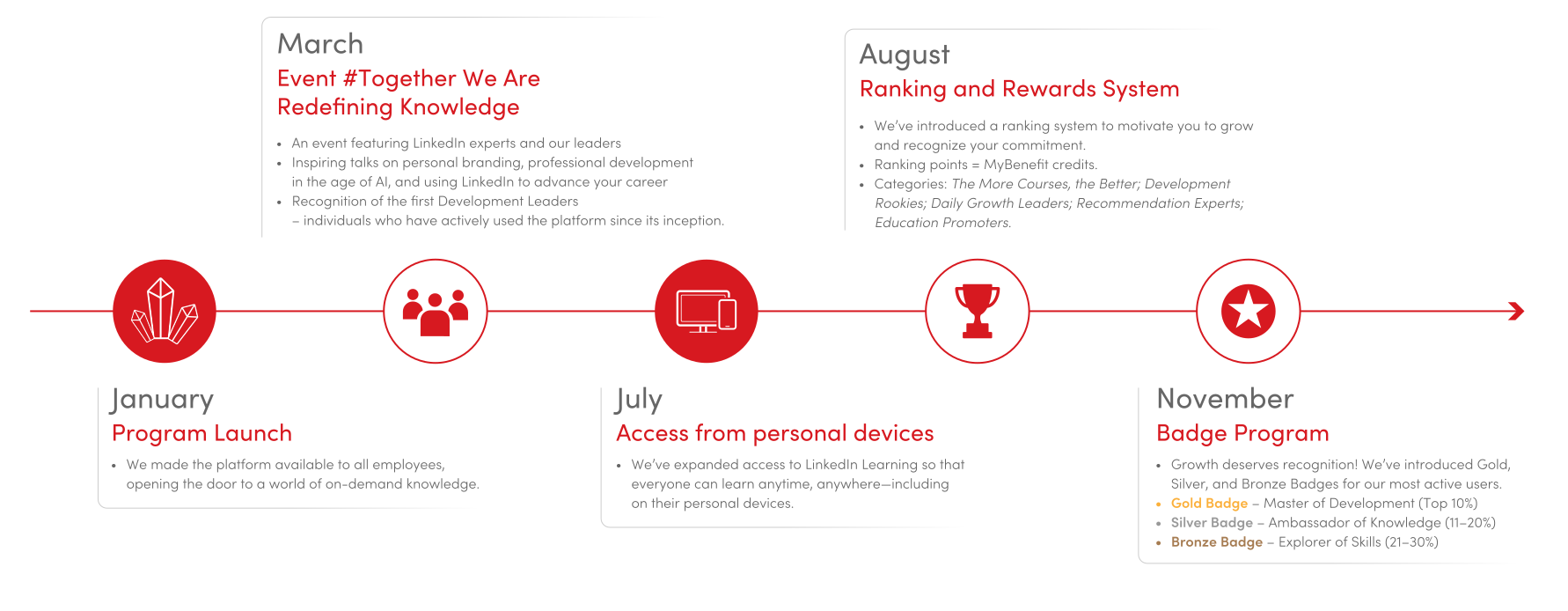
The Bank’s employees gained access to the LinkedIn Learning platform. The platform offers training with more than 20 000 online courses in areas such as digital competences, management, leadership, communication, and cybersecurity. The platform has become a key tool to support a culture of continuous learning, with implementation including:

  • creating a network of 37 LinkedIn Learning editors who promote valuable content, recommend development paths and support employees in using the platform,
  • launch of the Active with LinkedIn Learning incentive program, which, through a system of badges and rankings, promotes educational activity and distinguishes the most engaged participants,
  • implementation of communication campaigns and educational webinars that increase awareness of available development opportunities and encourage the use of the platform.

Cybersecurity training

We continue training our employees in the scope of Cybersecurity, the aim of which is to provide knowledge about conscious and safe use of the Internet, both at work and in private life.

AI & M365 Programs

In 2025, we began the phase of wider implementation of M365 tools, including Copilot. Employees of selected units, in particular those who work with a large number of documents, have been provided with an adoption and training program.

As part of the Transforming the Way of Working initiative, we have conducted training in the field of M365 tools and dedicated workshops on Copilot. Their aim was to improve the digital competences of employees and to disseminate the practical use of AI tools in everyday work. These activities contributed to organizing the way of working with tools and created the basis for increasing the efficiency of teams.These activities are part of the process of building a modern and more automated work environment. The trainings were carried out in cooperation with external partners.

We also continued the M365 and AI Ambassador programs, which are an important part of building a digital culture in the organization. Thanks to the involvement of the Ambassadors, we strengthened the adoption process of new tools, creating a space for sharing experiences, good practices and mutual support during regular community meetings.

ESG Programs

The training program, which started in 2024, continued into 2025. The project was addressed to all groups of employees, from the management through representatives of the risk and business area.

All the Bank’s employees took part in the ESG – Sustainable Development online training. Managers involved in ESG processes could take part in a training on Corporate Governance (G) dedicated to them.

ESG Employees and Ambassadors also participated in trainings covering the following issues:

  • social issues (S),
  • ESG and climate risk in the bank: new challenges and management strategies (E),
  • elements of decarbonisation of the credit portfolio (E).

ESG Ambassador Program

The ESG Ambassador Program is addressed to employees interested in deepening their knowledge in the ESG area and actively supporting the Bank's activities in the field of sustainable development. Employees of the Headquarters and the Bank's Network participate in the programme. The main objective is to increase the level of employee engagement in the implementation of the sustainable development strategy and to build the ESG community and culture at the Bank. Ambassadors also take part in training as part of the ESG Academy program.

As part of the program, the Ambassadors use a dedicated channel on the MS Teams platform, which is a space for the exchange of knowledge and experience as well as mutual inspiration. Participants also receive substantive support, including press reviews, news, market trends, reports, key legislative changes and good practices in the field of ESG. An additional element of the Ambassadors’ support are meetings in the Coffee with ESG series conducted by experts from the Bank.

We have also prepared a special offer for this group of employees, which was used by 25 people. The ambassadors took part in the online training How to work with clients in sustainable ESG investments?, the aim of which was to prepare them for the EFPA ESG certification exam.

The Ambassadors also had the opportunity to participate in the Young Energy Europe program, under which a team of 4 people developed and presented during the final of the program a project on CO₂ reduction – Intelligent Fleet Management at the Bank. Value Creation and Emission Reduction.

In addition, the websites of the ESG Academy and the ESG Ambassador Program are available on the bank’s intranet, which support and disseminate ESG activities and initiatives.

Realization of mandatory training programs required under internal and external regulations

In 2025, we completed mandatory training, with particular emphasis on regulatory training in the areas of Bancassurance, MIFID 2 and the Mortgage Directive. Trainings related to regulatory areas accounted for 34% of all trainings provided, which confirms the Bank’s consistent approach to improving employees’ qualifications in accordance with the expectations of the regulator and applicable law.

We have also organized a series of trainings in the field of Occupational Health and Safety (OHS), first aid and recognizing the authenticity of cash signs, as well as other training programs resulting from external regulations.

Development programs and initiatives

In 2025, we carried out business trainings, development and integration workshops. We conducted employee potential surveys: Gallup tests, Insight Discovery survey, 360-degree Feedback survey. The development activities were complemented by coaching processes carried out for both employees and teams.

For the first time, we launched the Talent DNA of the Team development program, based on the CliftonStrenghts34 study. The program included 20 teams in which 302 tests were conducted. The program consisted of 6 team workshops and an individual development path for managers.

We continued the implementation of the second edition of the Mission Development programme, in which 39 people participated. The project path has been completed, which resulted in the presentation of 6 developed solutions to the Leadership Council. Some of the projects, by the decision of the Mentor and the Sponsor, have been qualified for implementation in whole or in a selected scope or for further development work. As part of the program, we carried out individual coaching based on the Insights Discovery tools, workshops using improvisation techniques, workshops on giving both individual and team feedback, and workshops based on the CliftonStrengths tool. The participants also took part in the Development Map development workshops, carried out with the use of group coaching. Currently, individual coaching sessions with participants are being conducted.

We launched the first edition of the „Manager at the Start” program, a development initiative supporting newly appointed managers in successfully entering the leadership role. The program combines the transfer of key operational knowledge with the development of managerial competences. The programme is based on two pillars. The first includes a series of short recorded webinars on processes, regulations, recruitment, and HR issues necessary to work in a managerial position. These materials make it easier to efficiently navigate formal and operational aspects. The second pillar is a series of workshops developing practical leadership competences. The workshop part opens with a joint online workshop, after which participants are directed to one of two paths.

From Expert to Leader

Intended for people taking up the position of manager for the first time.

Leader in our organization

Addressed to experienced managers who are just starting their work in the bank.

The program supports conscious building of the role of a leader and enables quick finding oneself in organizational realities. As part of the project, an intranet website with training materials (webinars) was prepared and a series of workshops was carried out.

In the Sugar-Free Women’s Programme, we carried out development and educational activities resulting from the strategic objectives of the programme. The thematic offer of the programme was systematically supplemented and updated and included the development of professional, personal and parental competences carried out through trainings, workshops and webinars. The program also included development initiatives such as Conscious Leader or Excelentni, as well as activities supporting education and promotion of new technologies through webinars, technical trainings and programs such as Closer to Technology, emPower Women.


An important element of the programme were activities aimed at building pro-health awareness among employees. We carried out the Pink October campaign, in which 4 000 women participated, and the Blue November campaign, in which 2 200 participants took part.

We also continued the 2nd edition of the Development Program for Women Local Leaders, focusing on the development of leadership and project competences. At the end of the year, we launched the first edition of the mentoring program, under which 32 mentoring pairs started working together.

In total, more than 7 000 women took part in the activities carried out under the No Sugar Programme.

Managerial Shots is an online development program addressed to managerial staff. The program focuses on the development of soft skills in the field of management and leadership. It has been adapted to the needs of managers who cannot participate in long-term training. Each workshop lasts 45 minutes and provides specific, practical knowledge in a nutshell. In 2025, another 3 editions of the program were held, during which we carried out 36 workshops, attended by about 3.5 thousand managers. In the second half of the year, all workshops promoted and developed behaviours supporting the implementation of the Bank’s values.

As part of the programme m.in the following topics were implemented:

  • A leader close to people,
  • Effective management of the work of virtual teams,
  • Building authority based on trust and respect,
  • How to support an employee when their tasks are not carried out.

Snacks for Employees are short workshops for employees carried out in an online formula. In 2025, we conducted 20 workshops. All workshops promoted and developed behaviours related to the bank’s values. The topics covered included:

  • Teamwork,
  • Building mental resilience,
  • Competences of the future.

Apprenticeship program

We are consistently developing activities aimed at attracting graduates of the best universities in Poland and abroad, offering them the opportunity to build their professional path within the Bank's structures – both in the Headquarters and the Bank's Network.

As part of the next edition of the Banking Champions internship program, over 70 students and graduates from all over Poland joined the organization. The participants started working in selected units of the Bank, gaining practical knowledge about the functioning of modern banking. The programme provides practical experience in key areas of the Bank's operations, such as finance, risk, analytics, corporate banking, marketing, communication, HR and IT. The six-month internship formula enables the development of professional competences and real involvement in projects carried out by business teams.

The compensation strategy was developed in line with the business standards and values underlying the Bank’s mission and reflected in the internal regulations as well as it constitutes the basis for enhancing and protecting the Bank’s reputation and creating long term value for all the stakeholders. The key regulation in this area is the Remuneration Policy of Bank Polska Kasa Opieki Spółka Akcyjna, the last update of which was approved by the Supervisory Board of the Bank by resolution of December 16, 2022. This policy reflects the mission and values in the Bank’s approach to remuneration systems, including:

  • defines the compensation pillars, management of its structure, corporate and organizational processes,
  • confirms the compliance requirements of the compensation systems with the generally binding law,
  • defines the principles of market practice monitoring, and the approach to the matter of compensation systems which guarantees the sustainability of the Bank’s functioning.

The remuneration structure ensures a direct link between remuneration and performance by guaranteeing financial stability and variable remuneration levels appropriate to the Bank’s financial capacity, setting performance-based remuneration levels and developing incentive systems foreseeable the minimum levels of the Bank’s performance below which the bonus is not paid. Variable remuneration covers all remuneration components, the granting of which depends on the results, and its payment is directly dependent on individual achievements and the results achieved by the Bank and adjusted to the risk.

Sustainable results contributing to the creation of long-term value for stakeholders relate to the actual results achieved and how they are achieved, with a view to measuring results consistent with shareholders’ interests and profitability principles based on safe risk levels, sustainable risk management practices and a multi-dimensional performance analysis and quality of operation.

In order to ensure the competitiveness of the remuneration structures, as well as their transparency and an effective and fair remuneration system, the Bank monitors market trends in terms of forms of remuneration and the level of remuneration offered on the market. Decisions on the remuneration system at the Bank are made taking into account the available data on market trends in the area of fixed remuneration as well as incentive systems. Such data is obtained from consulting companies offering financial sector analyzes. In 2025, the Bank conducted analyses of wage coherence between women and men in identical positions, in order to compensate for the pay gap existing at the Bank.

The Bank also has a Remuneration Policy for Members of Supervisory Board of the Bank and the Management Board of Bank Polska Kasa Opieki Spółka Akcyjna, which sets out the framework principles and rules for determining, monitoring and controlling the remuneration rules and practices applied by the Bank in relation to the Members of its Supervisory Board and the Management Board of the Bank.

The Remuneration Policy for Members of the Supervisory Board of the Bank and the Management Board of Bank Polska Kasa Opieki Spółka Akcyjna supports proper and effective risk management and does not encourage taking excessive risks exceeding the acceptable general risk level approved by the Bank’s Supervisory Board; implementation of the Bank’s management strategy and risk management strategy; mechanisms for managing conflicts of interest occurring in the Bank’s operations and limiting them; as well as ensuring that remuneration and any related terms and conditions of employment that affect remuneration, including those relating to conditions for granting and payment of remuneration, are gender neutral, i.e. they are not differentiated on the basis of gender.

As part of the remuneration system, employees are offered non-wage benefits ensuring fair treatment and consistency of the remuneration system.

Each year, a report on the functioning of the Remuneration Policy at the Bank is prepared, which is then presented at the General Meeting of Shareholders in order to assess whether the functioning of the Remuneration Policy in force at the Bank, supports the development and security of the Bank’s operations.

Information regarding remuneration value of each Member of the Management Board is presented in the point 11, the section of the Management Board and the Supervisory Board Remuneration.

The Subsidiaries of the Bank’s Capital Group have remuneration policies adapted to the size and specificity of their activities and the remuneration principles.

In the Bank, there are three main incentive systems: an Executive Variable Compensation System, a System based on Management by Objectives (MBO), and a system based on provisions of Corporate Collective Labour Agreement, which is based on quarterly bonuses, bonus for retail sales forces and incentive reward.

The top management is covered by a variable remuneration system dedicated to people who have a significant impact on the Bank’s risk profile. The aim of the System is to support the execution of the Bank’s operational strategy and to mitigate excessive risk conflicts of interest. Participant covered by the system may receive a variable compensation based on a bonus pool approach. The System provides a comprehensive performance measurement at individual level, level of his/her organizational unit and results of the entire Bank, as well as verification of the participant’s compliant behaviour with respect to law provisions, and standards adopted by the Bank and risk assessment. For reinforcement of care for long-term welfare of the Bank, under the system at least 50% of variable remuneration is provided in phantom shares based on the value of the Bank shares and at least 40% of the bonus is deferrable and paid after the end of the evaluation period it is payable for.

Annual goals set for the Bank’s top management as part of the incentive system ensure consistency with the strategy of introducing sustainable development risks into the business in the investment decision-making process, and are consistent with the goals of the Bank’s business strategy and risk strategy, including environmental, social and governance risks. (ESG risk), are consistent with the Bank’s corporate culture and values, risk culture, including in relation to the long-term interests of the institution, as well as with the measures used to prevent conflicts of interest, and should not encourage excessive risk-taking.

The system of variable remuneration components is developed by People, Organization and CX Division, with the involvement and participation of other organizational units of the Bank, including Legal Department, Compliance Department, Risk Management Division, Financial Division, and in consultation with Internal Audit Department. This is to ensure compliance with the regulations, the Bank’s articles of association and the standards of ethical conduct or other standards of conduct applicable to the Bank, in such a way that legal, compliance and reputational risks mostly related to customer relations are properly controlled and managed.

Variable remuneration systems implemented in the Bank’s subsidiaries have schemes similar to the Bank for the division of remuneration into cash and financial instruments, taking into account general provisions and guidelines of market regulators regarding the sectors in which the subsidiaries operate.

MBO system covers employees employed under the management contract and refers in particular to the sales positions and to the managerial positions, which play a significant role in achieving the Bank’s commercial goals. Under the MBO system, employees receive individual goals for realisation, which result from the financial plan adopted for a given year and the Bank’s key goals. The amount of the annual bonus depends on the level of implementation of these goals, as well as the result achieved by the Bank. Sales functions employees, in each quarter, can receive an advance payment towards the annual bonus in achieving of the set goals.

In 2025, the Bank negotiated with trade unions to include in the Collective Bargaining Agreement employees employed under managerial contracts (employment contracts) covered by the „Remuneration Rules at Bank Polska Kasa Opieki Spółka Akcyjna Employees Employed under a Management Contract” (MBO system). The negotiations were conducted in good faith and respected the interests of the parties from January to June 2025. Due to the lack of agreement, the Bank decided to introduce three separate remuneration regulations for individual groups of employees covered by the MBO system so far, the assumptions of which are better suited to the specificity of the roles and functions performed by these employees. The remuneration regulations are in force from 2026.

The system based on the provisions of the Corporate Collective Labour Agreement (CCLA) applies to all employees who are covered by it. According to the provisions of CCLA the basis of the system is a quarterly bonus which is discretionary and depends on evaluation of employee’s performance, the level of commitment and the results achieved by the Bank in a given year, as well as the incentive bonus, which is granted for outstanding achievements in professional work. As in previous years, in 2025, guidelines for variable remuneration, i.e. the bonus for sales network employees covered by the CCLA. According to the guidelines, the employee bonus was awarded based on the employee’s individual sales results, taking into account the qualitative component. Determining the final amount of variable remuneration of employees covered by the Guidelines depended on the results of assessing the compliance of the employee with achieving goals or tasks.

The Bank has a Policy of selecting candidates for the position of a member of the Management Board and the key function as well as assessing the suitability of proposed and appointed members of the Management Board, Supervisory Board and persons holding key functions at Bank Polska Kasa Opieki Spółka Akcyjna (Selection and suitability assessment policy) approved by the Bank’s Supervisory Board on 30 December 2020. The aim of the Policy is to guarantee an optimal and uniform process of selecting candidates for the position of a member of the Management Board and the Key Function at the Bank, so as to ensure that tasks related to the implementation of the Bank’s plans and business strategy are performed by persons who have the necessary knowledge, experience and skills, and who enjoy get a good reputation.

The subsidiaries have implemented the Suitability Assessment Policies in accordance with applicable law.

The Bank has a Gender equality and diversity policy with regard to members of the Supervisory Board, members of the Management Board and persons holding Key Functions at Bank Polska Kasa Opieki Spółka Akcyjna (Gender equality and diversity policy) introduced on December 18, 2020 by the Order of the President of the Management Board, which defines the strategy in the scope of managing diversity of the Bank’s employees, including diversity with regard to the appointment of members of the Supervisory Board, members of the Management Board and persons performing Key Functions at the Bank. The gender equality and diversity policy define guidelines aimed at ensuring that the Bank’s employees can manage their careers, achieve success and evaluate their work on the basis of individual achievements, regardless of gender.

The purpose of the Bank’s diversity strategy referred to in the Gender Equality and Diversity Policy is to ensure high-quality performance of tasks by the Bank’s employees, including the selection of competent persons to perform functions in the Supervisory Board, Management Board and Key Functions at the Bank, first of all applying objective substantive criteria and taking into account the benefits of diversity.

The gender equality and diversity policy, in accordance with the legislative process in force at the Bank, was adopted by the Bank’s Management Board and approved by the Supervisory Board and in relation to Members of the Supervisory Board, by the General Meeting of Shareholders.

Gender equality enables the Bank’s employees to manage their career, achieve success and evaluate their work on the basis of individual achievements, regardless of gender.

The Bank’s cooperation with trade union organisations in the area of negotiations and consultations was conducted in accordance with the procedures and principles set out in labour law, respecting the interests of the parties and the principles of social dialogue. In 2025, 35 meetings were held (including 20 two-day meetings).

The meetings focused primarily on negotiations and arrangements resulting from internal labour law and generally applicable regulations, changes in internal labour law, arrangements for the use of the company social benefits fund and other topics related to collective employee rights.

The following agreements were signed in the scope of negotiations referred to in internal labour law and generally applicable regulations:

  • Agreement of 19 March 2025 on the adoption of the expenditure plan of the Company Social Benefits Fund for 2025,
  • Agreement of 3 April 2025 on measures concerning the terms and conditions of employment of employees taken over by Pekao Direct Sp. z o.o.,
  • Agreement of 16 April 2025 on the rules for the distribution of the incentive fund referred to in § 19 of the Company Collective Labour Agreement for 2024,
  • Agreement of 22 May 2025 on the amount of funds for the reclassification of employees of Bank Polska Kasa Opieki SA covered by the Collective Bargaining Agreement in 2025.

In 2025, the Bank conducted negotiations with trade unions regarding the inclusion in the Company Collective Labour Agreement of employees hired on the basis of management contracts (employment contracts) covered by the “Remuneration Rules at Bank Polska Kasa Opieki Spółka Akcyjna for Employees Employed on the Basis of a Management Contract” and at the same time not covered by the ‘Rules of the Variable Remuneration System for Management Staff – Participants who are not Members of the Management Board / Supervisory Board’. The negotiations were conducted in good faith, respecting the interests of the parties, from January to June 2025. Due to the lack of agreement, the Bank, after consultations with trade unions pursuant to Article 30(6)(1) of the Act of 23 May 1991 on trade unions, decided to introduce remuneration regulations for individual groups of employees covered by the bonus system based on the Management by Objectives (MbO) system, settled on a quarterly basis, annually in advance and settled quarterly and annually. In order to implement changes to the remuneration and bonus rules for this group of employees, the Bank first presented all employees with proposals to change the remuneration conditions by mutual agreement. The agreements were signed by 95% of employees. Due to the fact that 5% of employees did not agree to the changes by mutual agreement, the Bank applied the collective redundancy procedure in accordance with the procedure and rules set out in the Act of 13 March 2003 on special rules for terminating employment relationships with employees for reasons not related to the employees. The agreement on collective redundancy was concluded with three trade unions.

Additionally, with a view to continuously improving employee motivation, particularly among employees responsible for customer service, in 2025 the Bank, together with four trade unions, parties to the Company Collective Bargaining Agreement, agreed and signed on 19 November 2025, in the form of Additional Protocol No. 5 to the Collective Bargaining Agreement, a “Quantitative and qualitative bonus system for retail sales employees and Contact Centre sales employees”, constituting Appendix 4D to the Collective Bargaining Agreement. The Additional Protocol was registered by the Regional Labour Inspectorate in Warsaw. The bonus system for retail sales staff addresses business needs, introduces transparent criteria for acquiring bonuses, and supports employee motivation and commitment.

In 2025, there were four collective disputes at the Bank, initiated in 2016, 2019, 2021 and 2024 by one of the trade unions. As part of the collective dispute initiated in 2016, a protocol of disagreement was signed on 13 April 2022, ending the mediation stage.

Trade unions are able to post their newsletters and information on important employee matters, including dialogue with the employer, on the Bank’s intranet pages. In its relations with trade unions, the Bank has been guided by the principle of good faith in developing the best solutions in the field of collective labour law for both employees and the Bank

At the end of December 2025, employment in the Group amounted to 14,839 full-time positions (in the Bank and the companies consolidated under full consolidation method) compared to 15,101 full-time positions at the end of 2024. At the end of December 2025, the Bank’s employment amounted to 13,707 full-time positions compared to 12,602 full-time positions at the end of 2024.

The average age of the employees was 44.9 years, 76.7% of the employees are university graduates (78.6% in 2024), women represent 65.8% of the total workforce.

Search results